Ground sloping toward the house
If the soil grade falls back toward the foundation, rain runs to the wall instead of away, saturating the clay right where it matters most.
Drainage correction in Rio Rancho to manage monsoon runoff and stabilize soil moisture around your foundation, protecting slabs and piers from clay movement.
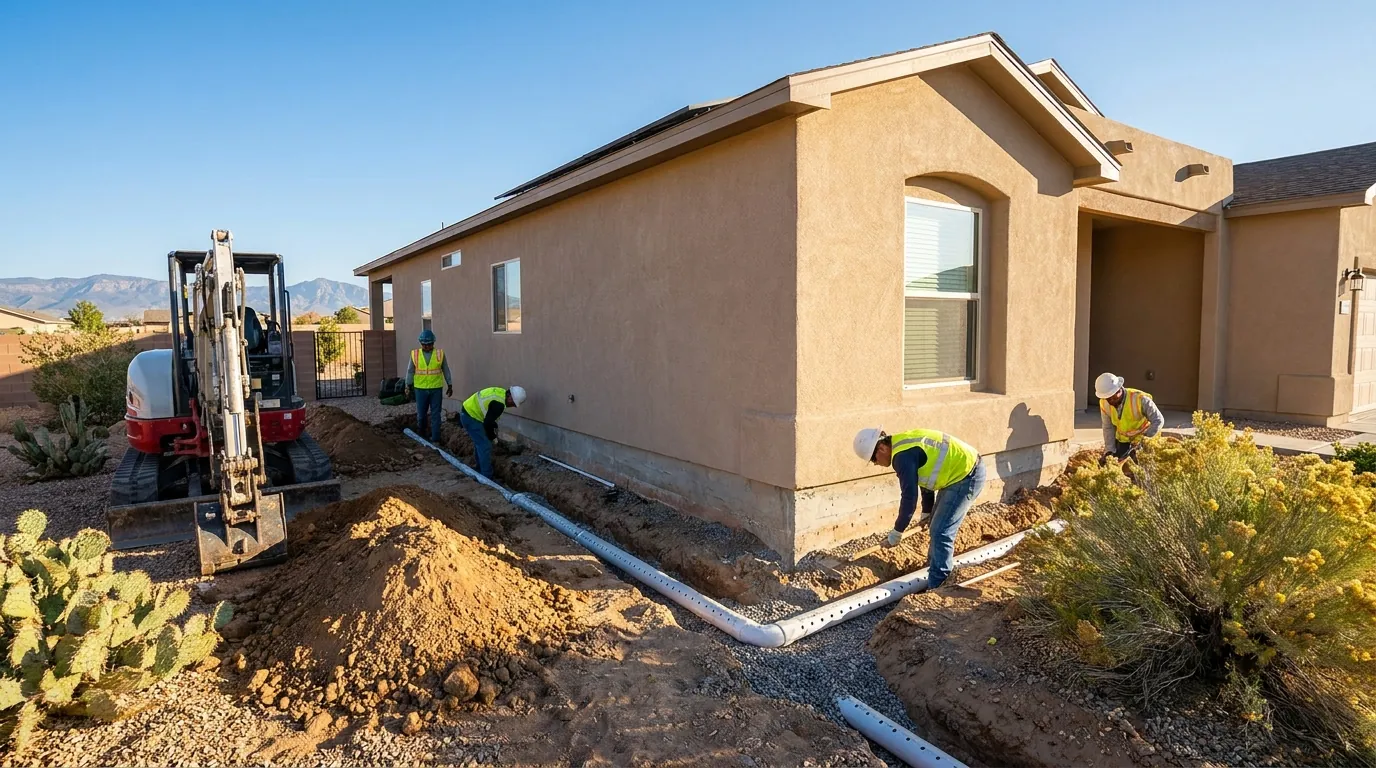
In Rio Rancho, water is the single biggest reason foundations move. The expansive clay in our soil swells when it gets wet and shrinks when it dries, so anything that concentrates water against the house, or lets it pool and then drain away, keeps that soil cycling. Drainage correction manages where water goes so the ground under the foundation stays as consistent as possible.
This matters because our rainfall arrives in extremes. Monsoon season delivers intense bursts that dump water faster than dry ground can absorb it, then the arid months bake everything out. Poor grading, missing downspout extensions, or a low spot beside the foundation turns each of those bursts into a soaking that swells the clay right next to the concrete.
Correcting drainage is often the difference between a foundation repair that holds and one that moves again next season. It is a standard companion to foundation repair and slab foundation repair, and sometimes it prevents the need for structural work in the first place.
These conditions push water toward the foundation and feed soil movement.
If the soil grade falls back toward the foundation, rain runs to the wall instead of away, saturating the clay right where it matters most.
Water discharged at the base of the house concentrates a large roof area into one spot of soil, driving strong local swelling.
Puddles that linger near the foundation for hours mean water is soaking in beside the structure rather than moving off.
Rills and displaced landscaping show where runoff is running hard against or along the foundation.
Persistent moisture under or beside the home points to water finding its way to the foundation.
Cracks that open and close around storms suggest the soil beside the foundation is swelling and shrinking with runoff.
The goal is to move water away quickly and keep soil moisture steady around the foundation.
We look at how the lot grades, where roof water discharges, and where water collects during and after a storm.
Soil next to the foundation is shaped to slope away, so rain runs off instead of pooling against the wall.
Downspouts are extended or routed to carry roof water well clear of the foundation soil rather than dropping it at the base.
In problem areas, surface or subsurface drains collect and carry water to a safe discharge point away from the home.
By evening out how wet and dry the perimeter gets, drainage reduces the swelling and shrinking that moves foundations.
Managing drainage in an arid climate is counterintuitive. It would be easy to assume a dry region has few water problems, but the opposite is true: because our soil is hard and dry most of the year, the sudden volume of a monsoon storm runs off and pools rather than soaking in evenly. That flash loading is exactly what swells clay against a foundation.
At the same time, long dry stretches pull moisture out of the soil, causing it to shrink and pull away from the foundation. The wider that swing between soaked and parched, the more the ground moves. Good drainage narrows the swing by preventing the worst soakings, which is why it protects foundations here even though it rains relatively little.
Drainage work also supports homes over crawl spaces, where standing water softens the soil that piers rest on. If your home is raised, pair drainage with crawl space support, and consider a foundation inspection to see whether water is already affecting the structure.
Describe what happens around your home during a monsoon storm and where the water goes. We can help you plan grading and drainage that keeps soil moisture steady.
Serving Rio Rancho, Corrales, South Valley, and nearby areas.
Often, yes. Because our foundation movement is driven by soil moisture swings, keeping water from soaking the ground beside the house reduces the swelling and shrinking that causes cracks. It is one of the most cost-effective steps a homeowner can take.
Usually it is recommended together. Repairing the structure without controlling the water that moved it leaves the underlying cause in place, so the two are commonly done as a pair for lasting results.
Our rain arrives in intense monsoon bursts that run off and pool rather than soaking in evenly. That flash loading swells the clay against the foundation, so managing runoff matters even where total rainfall is low.
Roof water should be carried well clear of the foundation soil rather than dropped at the base. The exact distance depends on your grade, but the principle is to keep concentrated roof runoff away from the perimeter clay.